
Coloured render gives kerb appeal
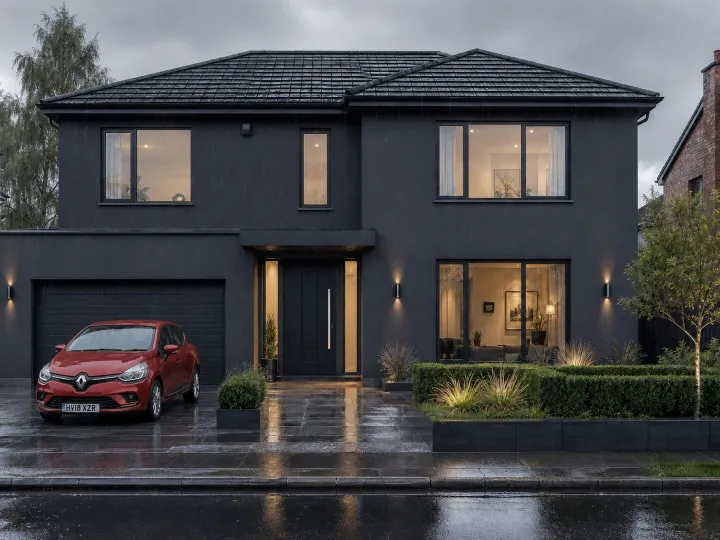
The development of coloured render has transformed house exteriors and their kerb appeal. A few decades ago, most UK homes had either bare brick or a flat sand-and-cement finish. Now, with creams, soft greys, warm clays, and bold tones from coloured renders, homes look fresh without the need for painting. Clients are often surprised by how much this enhances both kerb appeal and the feeling of coming home. A tired 1970s frontage can become crisp and modern simply by choosing the right system and colour.
Modern coloured render offers more than looks. Silicone and monocouche products offer better weather protection, lower maintenance, and greater longevity than traditional cement render, especially in the UK climate. Manufacturers now offer thousands of shades, letting us fine-tune finishes to the architecture, neighbourhood, and your property plans. This guide draws on our experience to explain coloured render options and how to choose a finish that elevates your home’s exterior.
What coloured render actually is
Coloured render is made with pigments blended at the factory, so colour runs through the material, not just on the surface. It’s called self-coloured or through-coloured render for this reason. If it chips, the shade remains, keeping a uniform look. It acts as both protection and decoration.
We mainly use two types of systems. Monocouche is cement-based, applied in a single thick coat, then scraped to create a textured finish in a chosen colour. Silicone thin-coat render is a polymer top coat in thin layers over a base coat, offering many colours and finer textures. Both provide lasting colour but suit different builds and design goals, so we match the product to the building.
Why coloured render boosts kerb appeal
A new render in the right tone quickly refreshes kerb appeal. Smooth or finely textured finishes hide old repairs, mismatched bricks, and dated pebbledash, replacing them with a clean, modern look. Agents and valuers often say a well-rendered, colour-balanced frontage makes a home easier to sell because buyers respond to first impressions.
Colour choice has the most impact. Soft off-whites, light greys and warm neutrals are safe, timeless options that fit most neighbourhoods. Bolder choices, like charcoals or earth tones, can define your home, but you should consider the local street scene and planning constraints. We suggest viewing real-life examples, then using colour charts and online simulators to make a decision.
Types of coloured render system
We specify three main coloured render types. Monocouche is a one-coat, through-coloured, cement-based render mixed with pigments and applied 15–20 mm thick, then scraped to create a textured finish. It is popular on new builds and extensions for its strong, even appearance and quick application.
Silicone-coloured render is a thin polymer system applied over a reinforced base coat, used on masonry and external wall insulation. These products are fully tinted to your chosen shade and offer flexibility, breathability, and water repellence, resisting cracks and stains. Acrylic renders are another thin-coat, pre-tinted option with vivid colours and good adhesion, but are less vapour-open and need careful substrate choice. Systems come in many textures, from smooth to rustic, letting us tailor both look and performance.
Performance, durability and maintenance
Modern coloured render outperforms old sand-and-cement systems. Silicone-based renders are hydrophobic and vapour-open, repelling rain while allowing moisture to escape from the wall. This keeps walls drier, reducing algae and frost damage. Some brands combine silicone with UV-stable pigments, so colours stay true for years, as we’ve seen on south-facing walls after many summers.
Coloured render’s low maintenance is a real benefit. The colour runs throughout, and the surface sheds water and dirt, so façades usually only need occasional cleaning with a hose or soft brush. Renders will age, and shaded or busy areas may show algae or grime, but overall, maintenance is lighter than with painted cement. Small marks are less obvious in self-coloured systems with light texture, keeping façades smart with less upkeep.
Choosing the right colour for your home
Colour selection can seem daunting, but it is manageable. We start with the property’s style: period homes suit traditional shades, while contemporary designs work with cool greys and bold blocks. Next, we consider the setting. Manufacturer advice and our experience suggest factoring in neighbours, planning guidance, and street character; some areas require uniformity, others allow variety.
We review fixed elements like roof tiles, bricks, windows, doors, paving, fences, and planting. The goal is to pick a render colour that unites these elements. Manufacturers offer colour wheels, sample boards, and online visualisers to test shades, helping clients choose among options. We advise against chasing trends; recolouring is not as simple or affordable as repainting a room, so pick a tone for the long term.
Costs, value and when coloured render makes sense
Coloured render systems usually cost more upfront than sand-and-cement with paint. Industry guides say self-coloured and silicone renders are premium options, due to material costs and the more complex application with basecoats and mesh. Silicone render averages in the low- to mid-tens of pounds per square metre, with monocouche in a similar range, depending on brand and spec.
Looking at the whole life cost, coloured render can be more economical over ten to twenty years. No repainting, better resistance to cracking, and a longer-lasting façade can offset the upfront spend. For properties being renovated for sale or rent, a high-quality coloured render boosts kerb appeal and desirability compared with cheaper finishes, which may aid marketing and valuation. It’s most valuable when the exterior is in poor shape or when external wall insulation is added, making coloured render the natural finishing layer.
Turning kerb appeal ideas into a reality
From our point of view, the most successful coloured render projects are those where appearance, performance and context all align. A carefully chosen shade applied in a quality silicone or monocouche system can completely transform an ordinary frontage into a confident, inviting exterior that feels right for both the building and its street, while also delivering better weather resistance and lower maintenance. Homeowners frequently tell us that the house feels “new” again, even if nothing inside has changed, simply because every time they pull up outside, they see a clean, well-balanced façade rather than mismatched brick, stains and cracks.
If you are starting to plan your own project, the best next step is usually to take stock of your property from the pavement, gather a few real-world examples that appeal to you and then sit down with an experienced installer or designer to match those ideas to the right coloured render system and specification. Our experience across different house types and neighbourhoods suggests that when colour, texture and product are chosen with care, modern coloured render does far more than cover walls; it becomes a long-lasting, protective “skin” that showcases your home at its very best.
Learn More
Elevate Your Space, Exceeding Expectations – Render Plaster UK: Where Precision Meets Excellence in Rendering and Plastering Services.
